Updated February 2025
Traveling by plane doesn’t inherently require anything other than what’s in your pockets right now. Everything else can be purchased when needed (e.g. umbrella, clothes) or will be provided where you’re staying (e.g. toiletries, towel). Yet for some reason everybody treats weekend trips by plane like they require an order of magnitude more stuff than crashing at a friend’s place.
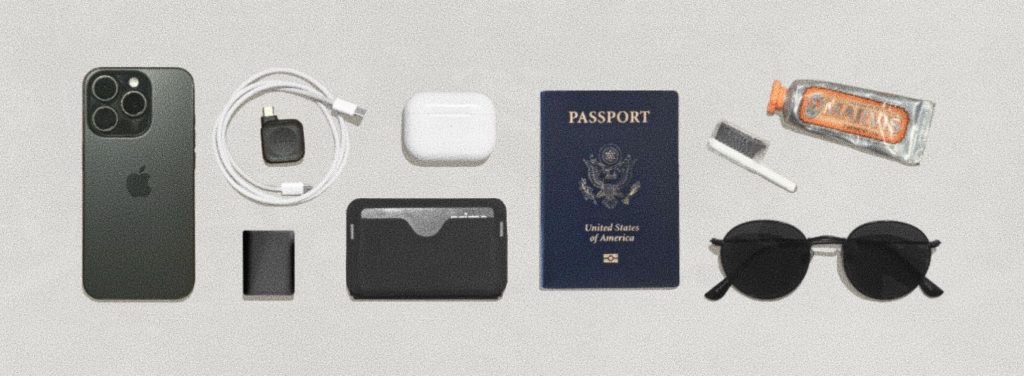
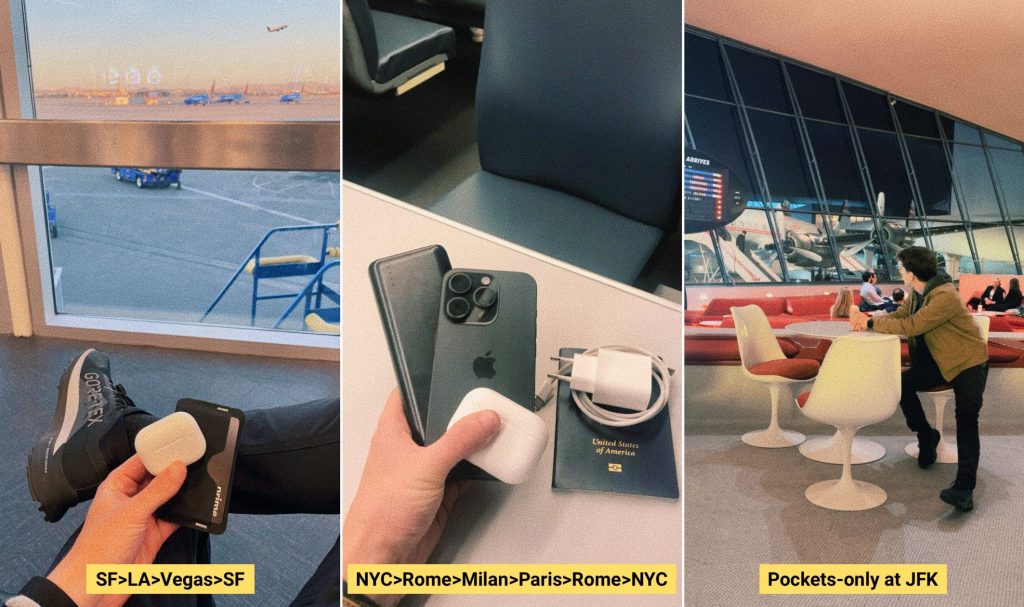
I realized this a few years ago and started traveling “pockets-only” for some of my shorter trips within the US, just bringing my phone, wallet, toothbrush and phone charger. Eventually I added my passport into the mix and tried it on longer international trips…and they all went effortlessly. It is legitimately the best way to travel. If you’ve ever read or watched Jack Reacher, it’s exactly like that.
I get asked a lot about the logistics, so this page will be a short guide.
Just to note: this travel style works best for people who are in good health and have experience with minimalist travel. There are also trips for which this won’t work, such as trips to places with minimal infrastructure, or trips that require a laptop or multiple outfits for work or events. And finally, none of this works if your daily routine requires specialty items like medication or makeup. If you don’t fit these criteria feel free to read on, but I don’t recommend trying this.
Pockets
Every item is technically optional. It is possible to travel without a phone, most hotels provide toothbrushes and personal care items, and you can survive without a credit card and ID. But the more you don’t bring, the more failure points you introduce. Efficient travel is all about reducing failure points, so if your ATM withdrawal gets flagged by the bank, you don’t become stranded.
- Phone. If you travel without one, you’ll end up paying more and doing less. Nearly all plane/train/bus tickets are mobile, on top of key items like maps, payments, and communication. As such your phone can become a failure point, so keep it charged, sort out cellular service before a trip, and plan contingencies for if it gets lost or stolen.
- Headphones. Optional, but for long flights or vehicle trips I recommend pocketable noise-cancelling headphones like AirPods Pro.
- Charger(s). A power bank or wall charger, or even both. Because you need chargers for all your tech (e.g. phone, headphones), be strategic so you need only one cable. Optional for short trips or if your hotel provides them.
- Wallet. Technically you just need one credit card, but that can be a failure point. I suggest a secondary credit card, and a secondary ID (e.g. driver’s license). If predisposed to lose things then ideally store the backups elsewhere on your person.
- Passport. Find a way to keep it secure. I added a custom pocket to the interior lining of my jacket, and some jackets are sold with pockets like this. Not needed for domestic travel.
- Personal care. I recommend bringing a toothbrush and toothpaste. You might also need deodorant, floss, sunscreen, hairbrush, and a razor, depending on your destination, your hotel, and personal preference, but any good hotel or gym can provide these, or you can buy them as needed. Hotels will also provide towels, soap, and other amenities.
Personal care is what will make or break this travel style for most people: you can maybe fit contacts or an inhaler in your pocket, but probably not a week’s supply of medication.
It’s worth noting that ‘pockets-only’ is somewhat biased towards men’s fashion, and women have the option of wearing a dress without pockets and carrying a small purse.
Accessories like a watch, sunglasses, or jewelry can be brought, but generally the more items you bring, the more mental overhead to keep track of everything. For situations where you may require an umbrella, simply monitor the forecast and buy one at a nearby store if needed.
Clothing
To address the elephant in the room: it’s easy to travel like this if you sacrifice personal hygiene. I do not endorse this. If someone can tell you’re traveling from your appearance or odor, you’re doing it wrong. If you take anything away from this post, please let it be that. I’m not a fan of how far vagabond-style travel has drifted from classy travel. There’s no reason you can’t do both.
At a high level, clothing can be divided into base layers and outerwear. Outerwear, such as coats, sweaters, shoes, jeans, gloves, buffs and hats, will stay clean indefinitely as long as you take care of them. If you often do activities that get your clothes dirty, don’t do them.
Base layers – your shirt, underwear, and socks – do require strategy, however, and will need to be replaced or cleaned daily. If you’re traveling to a warm climate you might only have base layers. There are three ways to handle them.
- The first strategy is to buy new clothes. If you start the trip with old clothes destined for the trash, you can replace those without being wasteful. However, once you reach the third day, you’ll have to throw good clothes out, which is not very environmentally-friendly. If you buy clothes at a thrift store you may be able to donate the shirt back, however, used socks and underwear cannot be donated. I don’t recommend this method unless necessary.
- The second strategy is to carry changes of clothes in your pockets. If you have a large coat with pocket space, I recommend this. However, most people don’t have the pocket space.
- The third strategy is what I recommend: do laundry at night. You’ll have to wash your clothes yourself as you’ll be naked. Some Airbnbs have laundry machines, but generally just a minute in a hotel sink with soap is enough, then leave it to dry on a chair next to the window while you sleep. You’ll wake up every day to fresh clothes. This option takes less time than shopping for new clothes, and is far more ethical.
Typically, weather will make a lot of your clothing decisions for you. In general though, traveling pockets-only to colder parts of the world is far easier than to warmer climates.
Traveling
Airports won’t give you trouble for traveling pockets-only, and passing through security checkpoints takes 10 seconds. Ultimately, trips end up feeling a lot more relaxed.
When booking your hotel or Airbnb, be sure to check the amenities list. Generally the more you pay the more amenities you get, but even the cheapest will include a towel and soap. I would not recommend hostels or shared Airbnbs unless you are certain they provide what you need.
I have not encountered any setbacks traveling like this, but the internet has presented many! Ignoring scenarios that don’t warrant attention, common hypotheticals have been along the lines of tripping in a puddle or spilling a beer on yourself. Crazy that I have to say it, but believe it or not, these are all the results of choices you make and not universal certainties!
Another note: I’d like this post to be as generalized as possible, however there’s one thing that makes traveling like this fit into my life seamlessly and it would feel dishonest to leave it out. I pay $5-10k per year for access to gyms and offices that essentially give me “home bases” everywhere.
For example, WeWork coworking spaces are in every major city worldwide, and if my cheap hotel is far from a city center, they can function as a rest stop during the day. Gym chains like Equinox or Lifetime have locations in every major US city, each a spot where I can relax in a sauna or reset in a shower. This helps maintain the refined, clean, streamlined feel of my trips.
You can achieve this for 5% of the price. Ten years ago, before flying pockets-only, I used to pay $10/mo for Planet Fitness and take $5 overnight bus rides to LA, back and forth, only bringing a pocket travel towel. Traveling pockets-only comes in many forms.
Final Thoughts
I’m not the first to travel pockets-only, but as no information exists online I hope this post can help those considering it. And there’s never been a better time in human history: tickets, cash, and everything that used to take up pocket space have all been replaced by apps!
Also, by pure coincidence, this is the most environmentally-friendly way to travel. No baggage results in far fewer airline emissions, and the inability to purchase souvenirs helps as well. There’s even a wider movement in this direction, with some cities banning suitcases and some airlines banning excess luggage to reduce carbon footprints and ‘undesirable tourism’.
All this said, I have no preconceptions that pockets-only will become a popular travel trend, at least anytime in the near future. But if you can imagine some future utopia in which you hop on a supersonic jet to a space station hotel, do you see yourself carrying a backpack?
Thank you for reading!
I send the occasional email to this list, including notes on projects and interests, travel adventure write-ups, and notifications for when I posts updates to this site.
100% human-written | instagram | twitter | youtube | hi@jeremymaluf.com